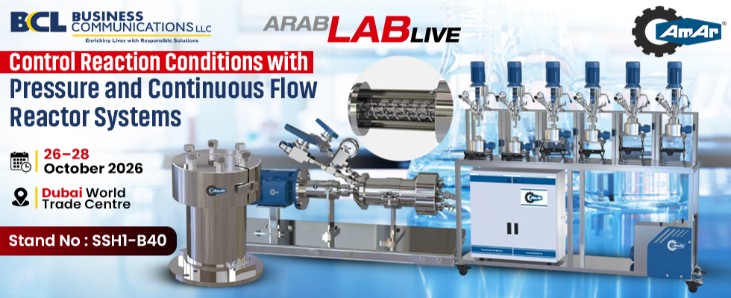
Chemical reactions can behave very differently when pressure, temperature, mixing or reaction time changes. In research and process development, controlling these conditions is important for getting repeatable results and understanding how a reaction may perform beyond the laboratory.
Amar Equipment Pvt. Ltd. develops pressure and flow reactor technologies for these controlled reaction studies. Its systems support work ranging from high-pressure batch reactions to continuous flow chemistry, helping researchers and process teams study chemistry under carefully managed conditions.
Two Ways to Control a Chemical Reaction
Some processes are better suited to a closed pressure vessel, while others benefit from reactants moving continuously through a reactor.
At ArabLab Live, Business Communications LLC will present selected Amar reactor technologies at Sheikh Saeed Hall 1, Stand SSH1-B40, giving visitors attending the laboratory exhibition Dubai 2026 an opportunity to understand where pressure and flow reactors can fit into process-development work.
Pressure Reactors: Control Reactions Under Elevated Conditions
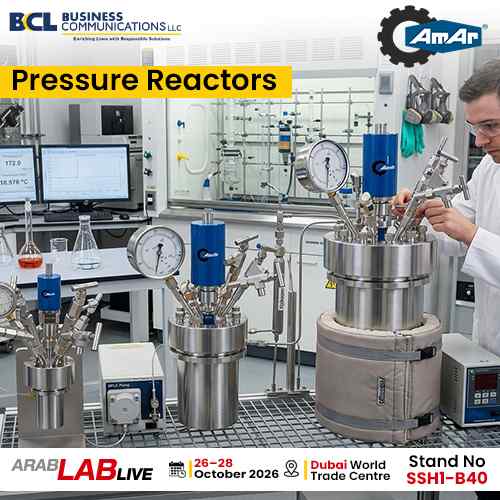
A pressure reactor allows a reaction to take place inside a closed vessel under controlled pressure and temperature.
Our Pressure Reactor Range is designed for laboratory, pilot and production-scale work, with systems used for areas such as process development, catalyst testing and reaction scale-up. The equipment can also be configured with agitation, heating, cooling and safety systems depending on the application.
A laboratory pressure reactor can be useful when work involves:
- Elevated pressure
- Higher reaction temperatures
- Gas-liquid reactions
- Catalyst studies
- Process-development work
- Scale-up studies
For teams working with a high pressure chemical reactor, the main value is the ability to control reaction conditions that cannot be safely or effectively studied in a simple open vessel.
Flow Reactors: Keep the Reaction Moving
Flow chemistry takes a different approach.
Instead of placing all reactants into one vessel and running the reaction as a batch, the materials move continuously through the reactor. Temperature, pressure and residence time can be controlled as the reaction progresses.
Amar's flow-reactor platform covers laboratory R&D through continuous manufacturing and includes different reactor configurations for varied chemistries.
A continuous flow reactor can support work involving:
- Flow chemistry development
- Continuous processing
- Reaction screening
- Process optimization
- Heat-sensitive or fast reactions
- Scale-up from laboratory studies
For researchers using a flow chemistry reactor, the benefit comes from being able to control how reactants enter, mix and move through the system.
Batch or Flow: What Changes in the Process?
The main difference is simple.
In a pressure reactor, the reaction takes place in a closed vessel as a batch.
In a flow reactor, reactants continuously enter the system and product continuously leaves it.
That difference can influence:
- Reaction time
- Mixing
- Heat removal
- Throughput
- Process control
- Scale-up approach
Neither method is automatically better for every chemistry. The right choice depends on the reaction itself and what the development team is trying to achieve.
Build the Reactor Setup Around the Chemistry
Selecting a reactor should begin with the reaction conditions rather than the equipment name.
Does chemistry require pressure? Is gas involved? Does heat need to be removed quickly? Would continuous processing make the reaction easier to control? Is the process still being developed, or is scale-up already being considered?
These questions help define the reactor approach.
What Should Be Considered Before Choosing a Reactor?
A few practical points can help:
- Required pressure and temperature
- Type of reactants involved
- Need for agitation or mixing
- Batch or continuous operation
- Reaction time
- Heat-transfer requirements
- Laboratory, pilot or larger-scale work
- Future scale-up plans
In simple terms:
- Pressure reactors are suited to controlled batch reactions under elevated pressure and temperature.
- Flow reactors are suited to continuous processing where reactants move through the system under controlled conditions.
Starting with chemistry makes it easier to decide which route is more practical.
Explore Pressure and Flow Reactor Technologies at ARABLAB 2026
At Sheikh Saeed Hall 1, Stand B40, visitors can learn how Amar's pressure and flow reactor technologies support different stages of reaction development.
The BCL team can help visitors understand:
- Batch pressure-reaction setups
- Continuous flow approaches
- Reaction-control requirements
- Laboratory and pilot-scale development
- Process scale-up considerations
- Different reactor configurations for different chemistries
For professionals attending the laboratory exhibition Dubai 2026, the stand offers a practical way to see how reactor design can influence control, consistency and process development.
Visit Business Communications LLC at Sheikh Saeed Hall 1, Stand SSH1-B40, from 26–28 October 2026 at Dubai World Trade Centre to learn more about Amar pressure and flow reactor technologies.